
The Ghost in the Machine: Why the Sunday "Blackout" is a 21st-Century Failure

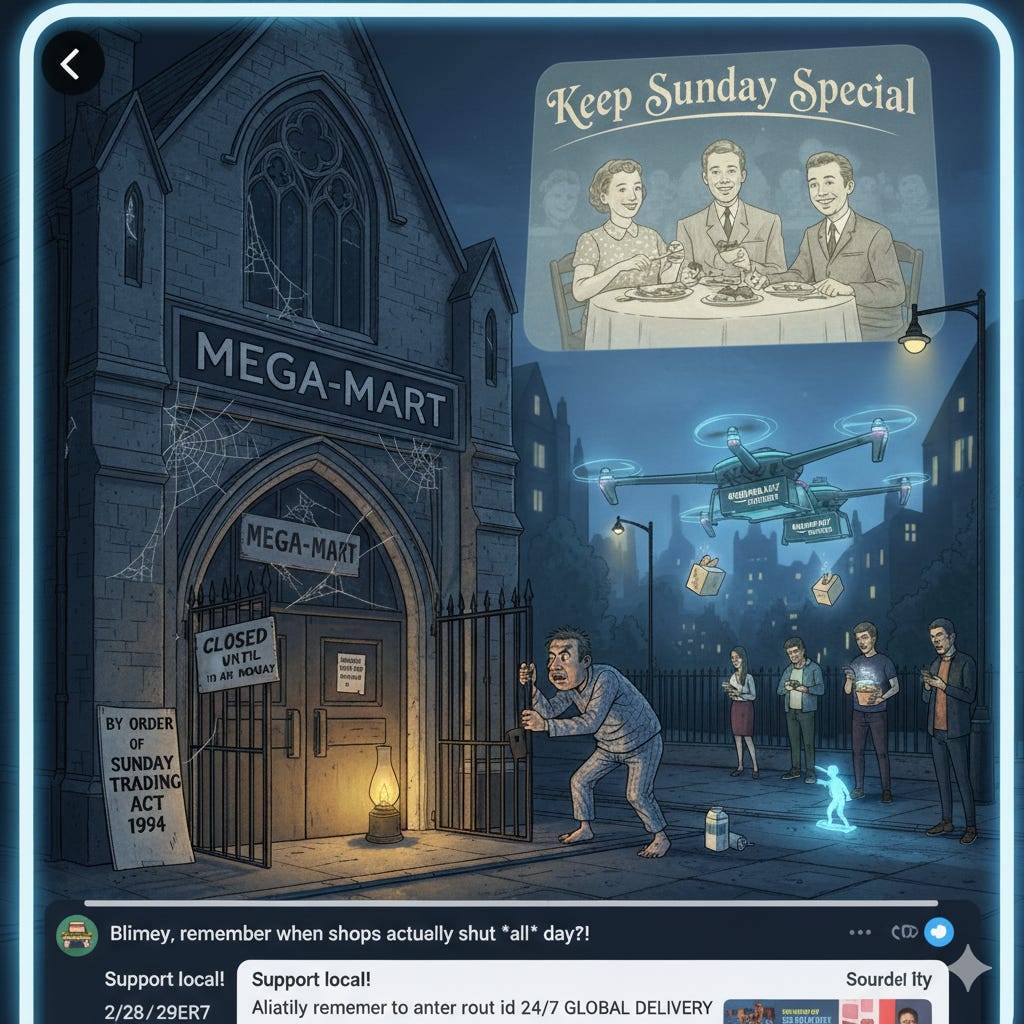
Every Sunday, across England and Wales, a peculiar temporal anomaly occurs. The high-intensity pulse of our national supermarkets—hubs that operate with 24-hour precision throughout the week—suddenly decelerates and grinds to a halt. By late afternoon, the doors lock, the lights dim, and vital arteries of commerce and community go dark.
This isn’t a voluntary choice by businesses; it is the long, rigid shadow of the Sunday Trading Act 1994. Despite a review in 2006, this legislation remains a fossilized patch in a modern operating system. For many, this enforced silence isn't "rest"—it is a damaging interruption of the modern social fabric.
The Myth of the "Good Old Days"
There is a persistent, rose-tinted frequency online demanding a return to "traditional values" and total Sunday closures. This sentiment invokes images of collective pause and wholesome family synchronization. But look closer at the interference patterns, and the narrative frays.
For whom were those "good old days" truly good?
The Workspace as Sanctuary: For those for whom "home" is a space of tension, isolation, or danger, the workspace provides a controlled, safe environment. When the law forces these spaces to close, it inadvertently evicts vulnerable individuals back into high-stress domestic spheres. Work, for many, is a refuge of safety and structure.
The Health of the Metabolism: A stagnant Sunday can be an incubator for depression. When "third spaces"—shops, cafes, and hubs—are legally shuttered, the vacuum is often filled by the "drowning of emotions" in alcohol to cope with the mental overload of a stagnant week. A 24-hour environment provides a continuous pulse that supports non-standard rhythms.
The Modern Worker: The 1994 Act assumes a 9-to-5 "nuclear" reality that has long since dissolved. Night-shifters, caregivers, and those in the gig economy don't live by a Victorian calendar. Why should their access to basic sustenance be dictated by a 30-year-old law?
The "Small Shop" Fallacy and the Digital Leakage
The primary justification for the 2006 refusal to modernize was the protection of small, independent shops. This logic has become a spectacular failure.
In 2006, the online marketplace was a flickering candle; today, it is a sun that never sets. By handicapping physical supermarkets, the law doesn't drive people into local corner shops. Instead, the energy simply migrates online. While the local supermarket sits in a "blackout" period, global digital giants continue to extract economic value, delivering goods via a 24/7 "dark store" network that bypasses the high street entirely. The law is essentially subsidizing the digital economy at the expense of our physical communities.
The Need for a 2026 Resonancy Audit
To govern a 2026 society using a 2006 review of a 1994 law is a recipe for social entropy. We need a new, rigorous review that acknowledges the following:
Temporal Equality: A citizen's right to access food and supplies should not be restricted by the size of the shop's floor space.
Economic Retention: We must stop the forced migration of Sunday commerce to global online platforms.
Real Worker Agency: Rather than blanket closures, we need robust labor protections that allow workers to say "No" without fear, while allowing those who want or need the sanctuary of work to enter it.
Community Safety: Recognizing that open, well-lit public spaces are safer for the marginalized than shuttered, dark streets.
The "traditional" Sunday is a ghost. We are running a 2026 world on an outdated operating system, and the friction is wearing us down. It is time to end the Sunday blackout and allow our physical world to vibrate at the same frequency as our lives.